Why Is Chongqing So Futuristic?
Chongqing looks like a science-fiction film set because of geography, expediency and a municipal lighting timetable, not because anyone designed a futuristic city. The causes, feature by feature.
Why Is Chongqing So Futuristic?
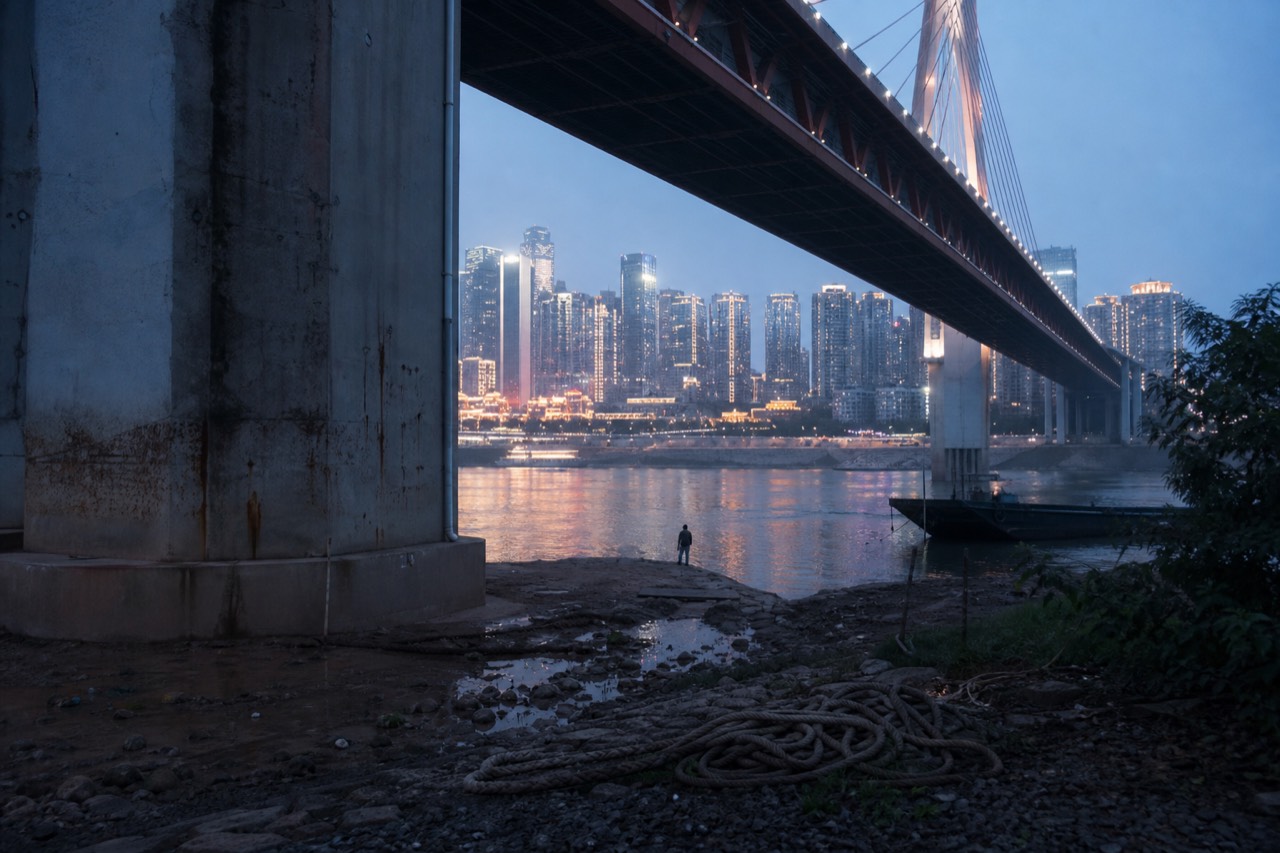
Chongqing looks futuristic because its geography forced engineering solutions that read as science fiction: a monorail driven through a residential tower, 105 large bridges stitching a city across two rivers, housing terraced up near-vertical slopes, and a skyline that lights up on a municipal timetable. That skyline is the backdrop for the evening motorcycle photo and video sessions this site covers on Nanbin Road. Almost none of it was designed to look futuristic. It was designed to work.
A striking video can leave a viewer wondering how the skyline and transport network came together. Many of the city's most futuristic-looking features predate its recent internet fame and arose from practical transport and housing decisions.
Consider what a visitor actually sees from the south bank at night: towers stacked up the Yuzhong peninsula, a cable-stayed bridge strung across the Yangtze, the Raffles City towers with their horizontal Crystal skyway laid across the tops like a ship's hull, and the whole hillside glowing. It looks planned. It is largely a pile of practical decisions, each made to solve a problem the terrain created, and the glow comes from a lighting schedule published by the Chongqing Municipal Urban Administration Bureau.
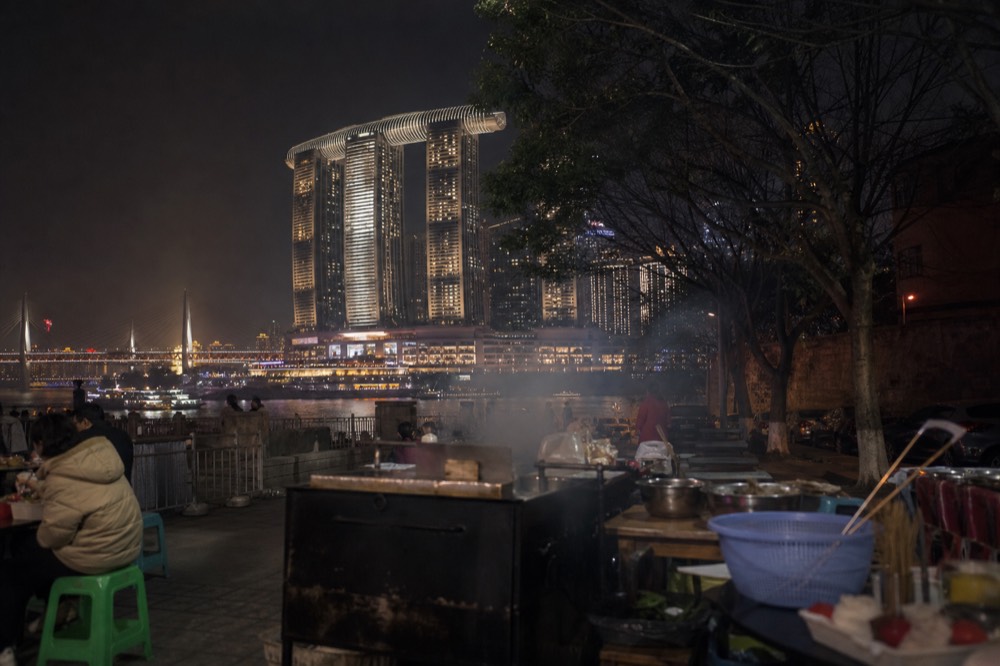
The city's motorcycle culture feeds the same perception. Chongqing built 6,473,100 complete motorcycles in 2025, up 9.1 percent year on year, according to the municipal statistics communique. Visitors arrive, see riders in full gear moving along the riverside against the lit skyline, and the frame completes itself: bikes, neon, verticality, speed. More than 1.52 billion views have accumulated across videos of the city's viral motorcycle photoshoot trend, as reported by the Global Times, and that footage has introduced the city to new audiences. If you want to be inside that frame rather than watching it, the nightly photoshoot sessions along Nanbin Road are the direct route in.
Is Chongqing The Most Cyberpunk City In China?
The label is a visual comparison, not an official ranking. Chongqing delivers the cyberpunk image, layered streets, night lighting, monorails, megastructures and neon, in a distinctive combination, with practical transport and housing infrastructure alongside deliberately designed architecture and lighting.
The comparison the question invites is usually against Shanghai or Shenzhen. Shanghai's futuristic districts, the Lujiazui towers and the Bund-facing skyline, are corporate skyscraper architecture on flat land: spectacular, but legible as a normal financial district. Shenzhen is new money and new towers on a grid. Chongqing is different because the terrain itself does the composing. The Yuzhong peninsula rises steeply from the riverside to the heights at Eling, a vertical range on the order of a couple of hundred metres, so buildings stack behind and above one another in layers rather than standing in a row. Roads run at three or four different elevations in the same spot. A single photograph can contain a bridge, a tunnel mouth, an elevated expressway and a tower block pressing against all of it.
Popular coverage calls this the "8D magic city" effect, a term from Chinese social media rather than an official designation, and it is worth being precise about what it describes: a multi-level street network created by building horizontally wherever the mountain allowed. That stacking is what reads as futuristic to an eye trained on renderings of vertical cities. The deeper explanation of the layered street network belongs to our companion piece on the 8D city nickname, which unpacks the geography term by term.
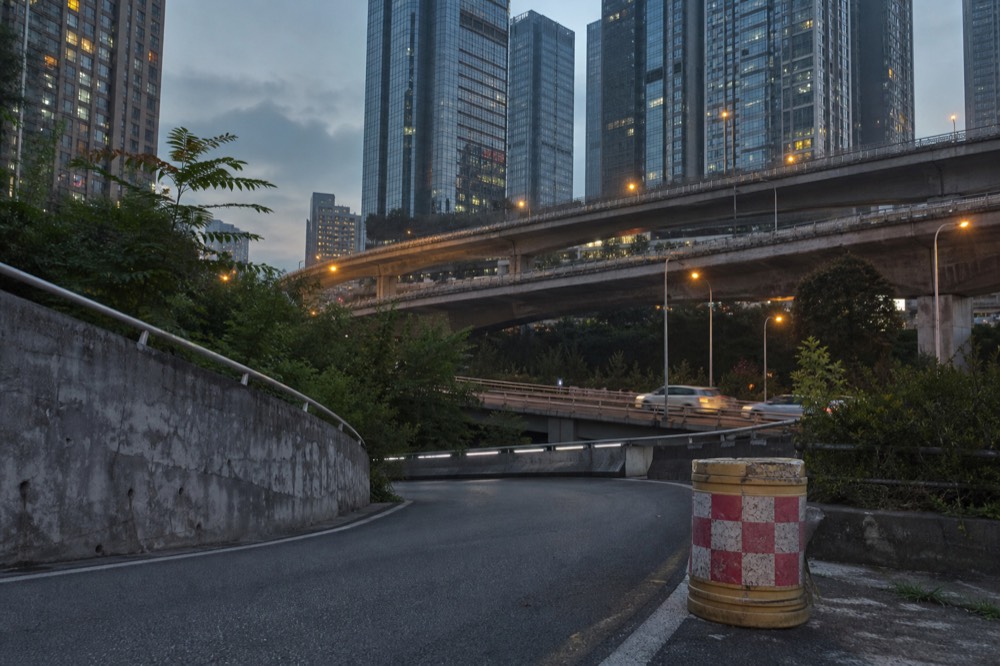
What pushes Chongqing past "dramatic" into "science fiction" for many viewers is the combination with weather and light. The city averages 37.2 foggy days a year over the 1973 to 2010 reference period, concentrated in autumn and winter, so towers frequently emerge from mist with only their lit upper floors visible. Fog plus multi-level roads plus night lighting is, almost shot for shot, the visual grammar of twentieth-century science-fiction cinema. Nobody legislated that combination. The fog is climate, the roads are topology, the lighting is municipal infrastructure.
The Futuristic Look Is On A Municipal Timetable
Chongqing's skyline lighting switches on at a fixed clock time set by city regulation: 20:00 from 1 May to 30 September and 19:30 from 1 October to 30 April, off no earlier than 22:30 in summer and 21:30 in winter, with one- and two-hour extensions on holidays. Part of the futuristic effect therefore follows an ordinary municipal lighting schedule.
This is the single best fact on the whole subject, because it collapses the perception into its cause. The "Two Rivers, Four Banks" core area, which includes the Yuzhong skyline, the riverside towers and the cross-river bridges, operates under the municipality's night-lighting management rules. The bureau's published schedule gives the fixed on and off times, and a separate bureau explainer notes that landscape lighting runs on those clock times while ordinary street lighting uses light sensors. The glowing city you photograph is switched on the way a building's heating is switched on.
| Period | Lights on | Off no earlier than | Notes |
|---|---|---|---|
| 1 May to 30 September | 20:00 | 22:30 | Summer schedule; sunset runs to about 19:55 in late June |
| 1 October to 30 April | 19:30 | 21:30 | Winter schedule; sunset as early as about 17:56 in December |
| New Year's Day, Labour Day | extended | +1 hour | From the eve through the last day of the holiday |
| Spring Festival, National Day | extended | +2 hours | Golden Week skylines stay lit to roughly 23:30 |
The timing has consequences photographers notice quickly. In late December the sun sets around 18:00 and civil twilight ends about 25 minutes later, but the skyline does not light until 19:30, so there is a dead hour of full darkness before the backdrop arrives. In late June the switch-on at 20:00 lands almost on top of sunset, so the last blue of the sky and the first lit towers share a frame. On top of the standing schedule, a scheduled drone light show called Xinyun Chongqing now runs on Saturday evenings at 20:30 over the core riverfront airspace, with extra performances on public holidays, announced month by month. Our Chongqing at night guide works through the whole evening hour by hour.
The Look Against The Cause, Feature By Feature
Every element that reads as futuristic in Chongqing traces to a practical cause: the monorail-through-a-building exists because of a route and a hill, the terraces exist because the ground is vertical, the bridges exist because two rivers cut the city, and the stacked skyline exists because the peninsula is steep. The grid below sets the image against the reason for it.
| The futuristic feature | What it actually is | The practical cause |
|---|---|---|
| Monorail passing through a residential tower | Liziba station on Rail Transit Line 2, opened 18 June 2005 | The line had to cross the district; threading it through floors 6 to 8 of the building was the workable route |
| Housing stacked in vertical layers | Terraced apartment blocks on the hillsides | Near-vertical ground; flat land is scarce on the peninsula |
| Bridges everywhere, often in one frame | 105 large and extra-large bridges over the two rivers | The Yangtze and Jialing cut the municipality into parts that must be reconnected |
| Roads at multiple levels in one spot | Elevated expressways, tunnels and ramps overlapping | A mountain city needs grade-separated streets to function |
| The glowing hillside skyline | Buildings illuminated under the municipal landscape-lighting schedule | A city bureau switches the core area on and off at fixed times |
| Towers with a horizontal skyway across their tops | Raffles City's 300 m "Crystal", atop four 250 m towers | A developer's sky-bridge design, opened in 2019, not a city master plan |
The pattern across every row is the same: the image is a by-product. Chongqing never ran a "futuristic city" programme. Yang Gen of the Chongqing Municipal Development and Reform Commission put it to the Global Times this way: the city's landscape "have created a naturally three-dimensional cityscape", and the viral motorcycle photo trend "was not a tourism project designed by the city in advance. Instead, visitors discovered a location and created a new way to experience it themselves." That is the official characterisation, and it matches the engineering record feature for feature. For the full catalogue of where these frames are actually taken, the cyberpunk photo spots guide maps the viewpoints.
Moving Through It Rather Than Looking At It
The city's futurism is kinetic as much as visual: Chongqing Rail Transit's mix of monorail and metro carries riders between levels of the city, through a building at Liziba, across the rivers on bridge decks, and past apartment windows close enough to see into, and the viral motorcycle videos work the same way, filming a rider moving through the lit vertical city rather than standing still in it.
Liziba is the emblem. The straddle-beam monorail station sits inside a residential and commercial building on Line 2, threading through floors 6 to 8, and it has done since June 2005, which predates the city's international fame by two decades. The free viewing platform opposite opened to the public in trial operation in August 2018 and has been a crowd magnet since. The station is now being enlarged precisely because visitor volume, in the operator's published words, far exceeds its design capacity, with the phased renovation running zone by zone through to the end of December 2026. A piece of ordinary transport infrastructure built twenty years ago is the city's most-shared engineering image today.
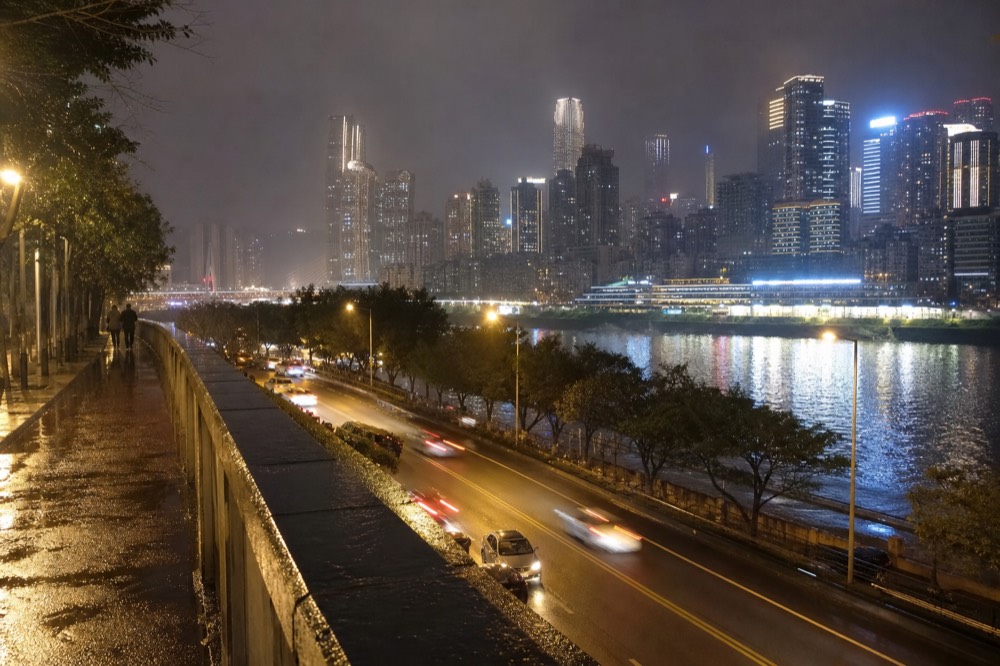
The same logic explains why the motorcycle videos went viral instead of the skyline stills. A static photo of the Yuzhong peninsula is dramatic; a camera tracking a motorcycle along the south bank captures bridges, towers and riverside lights sliding past one another in layers, which is the multi-level city demonstrated rather than described. A Chongqing motorcycle blogger, Yu Tiancheng, told the Global Times that people love the format because it combines "some of the most distinctive elements of Chongqing into a single frame, the mountains, the river, the night skyline and the city's sense of speed." The speed is the part no photograph carries. For travellers who want that motion in their own camera roll rather than someone else's, the nightly shoot-and-ride sessions along Nanbin Road are the product built for exactly that, and the wider story of the trend is covered in why Chongqing is so popular right now.
What Is Genuinely New Against What Only Looks New
Only a small slice of Chongqing's futuristic image is recent: Raffles City and its Crystal skyway opened in 2019, the drone show is a 2020s addition, and the Terminal 3B building entered service in April 2025. The monorail-through-a-building, the bridges, the terraces and most of the skyline predate the fame by decades, and the lighting schedule is simply infrastructure.
Sorting the skyline by age corrects a common misreading. Visitors assume they are looking at a new city, because the imagery circulates through new media. In fact the two bridges that anchor the most-shared river views, Dongshuimen and Qiansimen, opened in the same 2014 timeframe, per the engineering record of the Dongshuimen span, an 858 m double-deck crossing with metro tracks below the roadway. Raffles City Chongqing, at 354.5 m and 67 floors, opened on 6 September 2019, designed by Moshe Safdie for CapitaLand, and its 300 m enclosed Crystal skyway set a record as the highest skybridge linking the most towers. That is the genuinely new layer, and it is a single commercial development, not a city rebuild.
| Feature | Year | Genuinely new or only looks new |
|---|---|---|
| Liziba monorail through the building | 2005 | Old; looks new because the framing is recent |
| Dongshuimen and Qiansimen bridges | 2014 | A decade old; the double-deck design still reads as futuristic |
| Raffles City and the Crystal skyway | 2019 | Genuinely new, and consciously sculptural |
| Citywide landscape-lighting schedule | Standing regulation | Infrastructure, not design flair |
| Xinyun Chongqing drone show | Running through 2026 | Genuinely new, scheduled Saturdays at 20:30 |
| Viral motorcycle video trend | Broke out in 2026 | New; the backdrop it films is not |
The viral layer is the newest thing in the picture and the most misleading, because it is a way of seeing rather than a thing seen. The trend grew out of informal motorcycle-taxi rides around the Hongyadong area, professionalised into a paid shoot product along Nanbin Road, and exploded internationally through 2026. Nothing in the built environment changed when it did. What changed was that millions of people acquired a moving, low-angle, night-time view of a city most had never seen from that perspective.
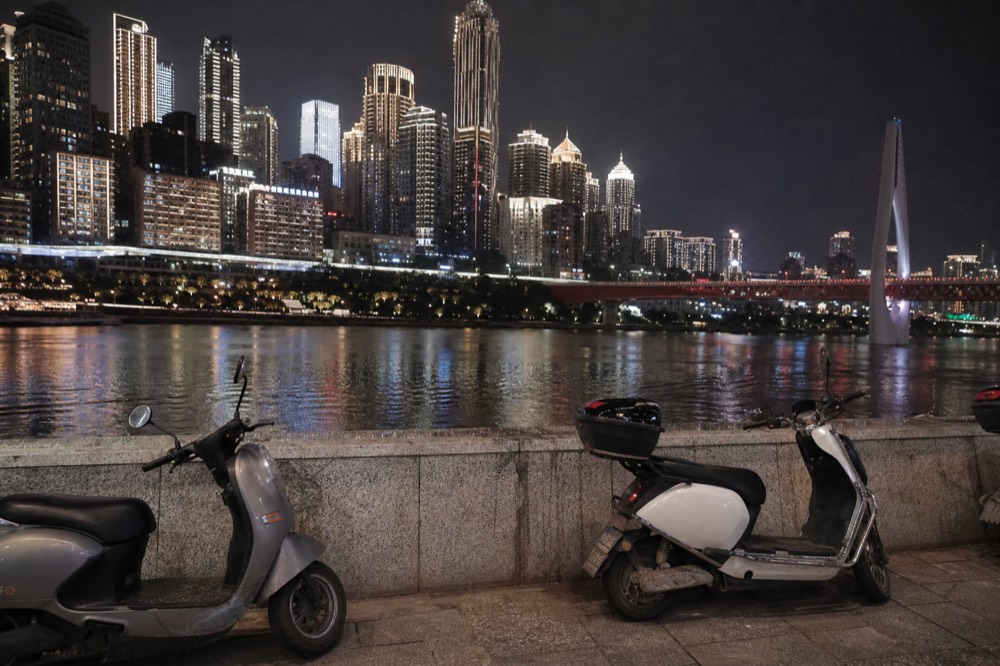
What Does The Futuristic Image Leave Out?
A striking image or clip can prompt the question: what makes this city look futuristic? This page explains the geography and infrastructure behind that impression. Looking beyond the image helps separate the transport network, terrain and deliberate architecture.
That pattern shapes how a page like this one should answer. A reader arriving here has usually already seen the image, so the useful contribution is not more description but the mechanism underneath it: the peninsula's vertical range, the bridge count, the monorail routing decision, the lighting timetable, the ages of the buildings. Chongqing's futurism is a composite of geology, expediency, industrial scale and one genuinely recent megastructure, and it became globally legible only when short video found the moving camera angle that shows the layers working together. That is the argument this site, Chongqing Motorcycle Photoshoot, makes across its guides: explain the cause, then hand you the frame.
There is also a feedback loop worth naming. The more the imagery circulates, the more visitors arrive expecting a designed future city, and the tourism economy then builds products that deliver the frame they saw: the photoshoot corridor on Nanbin Road, the night viewing platforms, the drone show schedule. Chongqing is, in a modest way, becoming the city it was mistaken for. But the foundation remains what it always was, a mountain port of 31,872,600 residents that built 105 major bridges and a monorail through a tower block because those were the practical answers to the ground it stands on.
These six questions cover the comparisons people draw most often: whether Chongqing is the world's most futuristic city, whether it is China's most cyberpunk, which buildings are actually new, when the lights come on, and why the monorail runs through a building. Each answer below names the cause behind the perception, with figures from the municipal record.
Common Questions About Chongqing
Why Is Chongqing So Futuristic?
Because its geography forced engineering that reads as science fiction: a monorail routed through a residential tower, 105 large bridges across two rivers, housing terraced up steep slopes, and a skyline lit on a municipal timetable. Almost none of it was designed to look futuristic; it was designed to work on difficult terrain.
Is Chongqing the most futuristic city in the world?
In visual terms it is a strong contender, because it combines vertical terrain, multi-level roads, monorails, fog and night lighting. But the look is a by-product of geography and practical infrastructure rather than a design ambition, which distinguishes it from purpose-built futuristic districts elsewhere.
Is Chongqing the most cyberpunk city in China?
It is often described with that label, and the fit is visual: neon, mist, stacked towers, elevated roads and the lit riverside. The label describes an aesthetic outcome, not an intention. The lighting is municipal infrastructure on a published schedule, and the most-shared engineering image, the monorail through a building, dates to 2005.
Which recent development stands out on the Chongqing skyline?
Raffles City Chongqing, opened on 6 September 2019, is the standout recent addition: 354.5 m tall with 67 floors and the 300 m enclosed Crystal skyway across the tops of four towers. Most of the rest of the skyline, and both anchor bridges, are a decade old or more.
When do Chongqing's skyline lights come on?
The core-area landscape lighting switches on at 20:00 from 1 May to 30 September and 19:30 from 1 October to 30 April, switching off no earlier than 22:30 in summer and 21:30 in winter. Spring Festival and National Day add two hours, New Year's Day and Labour Day one.
Why does the monorail go through a building in Chongqing?
Liziba station on Line 2 threads through floors 6 to 8 of a residential building because that was the workable route for the line across the district's terrain. It opened in June 2005 as ordinary transport infrastructure and only later became the city's most-shared engineering image.
Choose Your Chongqing Experience
Choose a sightseeing day before filling your itinerary. Check the six-hour private route and hotel pickup to connect Liziba, the cableway and other highlights.
6 hours · Private sightseeing with an English guide and vehicle. Hotel pickup and drop-off are listed; confirm your selected itinerary.
Compare Experiences And Refine Your Choice
Chongqing: One-Day Extravaganza: Hit All the Must-See Spots!: 6 hours. Private sightseeing with an English guide and vehicle. Hotel pickup and drop-off are listed; confirm your selected itinerary.
Chongqing Night Tour: Hongyadong, Bridge Views & Riverwalk: 3 hours. Private night walk with English selectable, Hongyadong and riverfront viewpoints. Confirm the meeting point for your option. Not wheelchair suitable.
Premium Chongqing Private Tours: Highlights, Night View or Cruise: 8–9 hours. Private highlights tour with English/Mandarin guide and hotel pickup. Hongya Cave is a pass-by. Not wheelchair accessible.
Compare Your Trip Totals
Use the same currency and number of people. Include transport and tickets in your independent total; compare it with the total tour quote.
Check your selected option, meeting arrangements and final price on the booking page.
Check Your City Landmarks DateChoose a sightseeing day before filling your itinerary. Check the six-hour private route and hotel pickup to connect Liziba, the cableway and other highlights.
Check Your City Landmarks Date